Top 6 Commercial Food Storage Containers of 2026: Bulk to Deli
As an Amazon Associate I earn from qualifying purchases. When you click a product link on Restaurant Week Hawaii and buy something on Amazon, Amazon pays us a small commission; the price you pay is the same. Learn more.
Size first, then NSF status, then whether the closure type suits your rotation — those three decisions narrow the field fast.
Start with capacity. The picks here range from disposable 8 oz deli cups to reusable 22Qt bins; picking from the wrong end wastes money in either direction. A 22Qt container is the right tool for bulk flour or a brine; a GN 1/6 pan is the right tool for a prep table rail. They are not substitutes, and no container does both jobs well.
Next, check NSF status. Three picks in this set state NSF certification — BIEAMA, HNEDSEN, and West Bay. If your operation falls under any health inspection or food-service regulation, that claim on the listing is the fastest screen. The others do not state it; that is a gap, not a failure, but it matters before you buy.
Third, match the closure to how you use the container. Snap lids lock quickly for transport; flip-top lids stay on during service without full removal; a standard lid stacks well but does not confirm airtight performance. TSUBOR’s listing explicitly confirms an airtight seal — no other listing here does.
Finally, weigh the reusable-vs-disposable split. Five picks are designed for repeated use; Dipoo’s deli containers are disposable. High-throughput takeout has a logic for single-use packaging; in-house storage does not.
If you only read one section
BIEAMA's NSF-certified 22Qt polycarbonate containers lead for bulk prep and brining. For standard GN 1/6 prep table slots, HNEDSEN's 12-pack fits that footprint directly and adds microwave-safe range the BIEAMA lacks. Dipoo's 60-set mixed pack is the pick only when single-use portioning — not reusable bulk storage — is the actual need.

Picks you can check yourself
None of these containers were handled. Each pick comes from comparing manufacturer listing specifications: capacity, material type, NSF and BPA claims, temperature range, dimensions, closure type, and pack count. Where one listing states a spec and another does not, that gap is called out in the relevant product block — the absence of a claim is treated as unknown, not as a failure.
Those judgments require use over time. Check the live listing before ordering; specifications can change after publication.
7 listings were compared on item volume, item weight, capacity and container shape. 1 was set aside (1 beaten on a listed spec). No product was bought or physically handled: every figure is the manufacturer's listing value. Produced by Cooking Equipment & Food Prep Desk. Editorial responsibility: restaurantweekhawaii.com.
Which pick is best for what
The table maps each pick to its primary use, with capacity, weight, and price band as the deciding columns. Item volume anchors the capacity comparison. NSF certification status — the most important spec not shown in the table — is covered in each product section above. Weight matters most for the 22Qt bins, which run to 16 lb before any food load is added.
| # | Product | Item Volume | Item Weight | Capacity | |
|---|---|---|---|---|---|
| 1 | 1 quarts | 16.4 pounds | 22 quarts | Check price | |
| 2 | 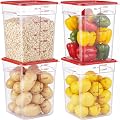 4 Pack Food Storage Containers with Red Lids, 22.0 Qt -…Best for Rotation Tracking | 22 quarts | 16 pounds | 22 quarts | Check price |
| 3 |  12-Pack NSF Polycarbonate Food Pans with Lids,1/6…Best for Prep Stations | 1.5 quarts | not stated | 1.5 quarts | Check price |
| 4 |  9-Pack 1/6 Size 4''Deep NSF Polycarbonate Food Pans with…Best Value GN Pan Set | 1.5 quarts | 3.07 kg | 1.5 quarts | Check price |
| 5 |  Yungyan 8 Pcs Restaurant Food Storage Containers with…Best Multi-Size Reusable Set | 8 liters | 2.67 kg | 4 quarts | Check price |
| 6 |  60 Sets (120-Piece) Deli Containers with Lids, 32/16/8 oz…Best for Single-Use Portioning | not stated | not stated | 80 pounds | Check price |
Which one fits you
- Bulk prep or brining large batches 22Qt, NSF-certified PC, handles with drainage holes BIEAMA 22Qt square containers
- Standard GN 1/6 prep table fit 6.9×6.3 in footprint, GN 1/6 compatible, 12-pack HNEDSEN 12-pack GN 1/6 pans
- Cold prep storage on a budget Lower-priced, NSF certified, rated to -50°F West Bay 9-pack GN 1/6 pans
- Ingredient rotation with date tracking Airtight confirmed; date and contents fields built in TSUBOR 22Qt containers
- Mixed-size reusable set for small kitchens 8-piece set, 2Qt and 4Qt sizes, snap lids Yungyan 8-piece PC set
- Single-use takeout or deli portioning 60 sets, 32/16/8 oz mixed, BPA-free polystyrene Dipoo 60-set deli containers
Pick by pick
BIEAMA 22Qt square containers — bulk storage with NSF credentials
 1 · Best Overall
Why we picked it: Four NSF-certified 22Qt polycarbonate containers with shatterproof construction and drainage-hole handles; the right choice for bulk prep or brining.
- 1 quarts Item Volume
- 16.4 pounds Item Weight
- 22 quarts Capacity
- Square Container Shape
Who it’s for Commercial kitchens prepping or storing in bulk batches
Who it’s not for You need GN 1/6 format pans — HNEDSEN and West Bay both fit that slot.
Against the next pick: BIEAMA states NSF certification; TSUBOR matches the 22Qt capacity but its listing does not state NSF.
Also sold as: 4.0 quarts / Round, 18.0 quarts / Round, 6.0 quarts / Round, 4.0 quarts / Square.
At 11.22 × 11.22 × 15.75 inches, one container swallows a full dough batch or a large brine. Polycarbonate construction is NSF certified and rated from -22°F to 212°F, covering both deep freezer pulls and hot-fill applications. Scale markings in quarts and liters run on both sides; the handle includes a drainage hole so the container dries quickly between cycles. Sold as a 4-pack.
The weight trade-off is real: 16.4 lb per container before any food load means every full carry needs two hands and a clear path. The lid is a standard lid type rather than a locking or confirmed-airtight closure — TSUBOR’s listing explicitly states airtight performance where BIEAMA’s does not. Available in round formats from 4Qt to 18Qt as well.
Full listing specifications
TSUBOR 22Qt containers — airtight and rotation-ready
 2 · Best for Rotation Tracking
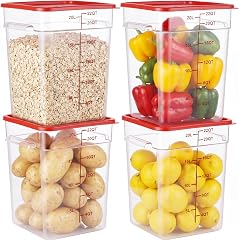
Why we picked it: Four 22Qt polycarbonate containers with confirmed airtight lids, dual-sided graduation marks, and date and contents fields built into the body.
- 22 quarts Item Volume
- 16 pounds Item Weight
- 22 quarts Capacity
- Square Container Shape
Who it’s for Kitchens running FIFO rotation that want labeling built in, not taped on
Who it’s not for NSF certification is a compliance requirement — BIEAMA states it and TSUBOR does not.
Against the next pick: TSUBOR holds 22Qt vs HNEDSEN's 1.5Qt per pan; HNEDSEN has NSF certification and a GN 1/6 footprint for prep tables that TSUBOR cannot match.
Not stated on the listing: material type, closure type. Also sold as: 4.0 Qt-Green Lids, 2.0 Qt-Green Lids, 8.0 Qt-Blue Lids, 18.0 Qt-Red Lids.
The date and contents fields molded into the container body separate TSUBOR from BIEAMA at the same 22Qt capacity. Dual-sided graduation marks — quarts and liters — run both sides, and the listing confirms airtight performance. Non-slip handles on both sides aid two-hand carries. Footprint is 11 × 11 × 15.75 inches, 16 lb, nearly identical to BIEAMA’s profile.
What the listing does not state: material type in the spec sheet (the description references polycarbonate but leaves that field blank), closure type, and NSF certification. For kitchens where certification documentation is a compliance requirement, BIEAMA carries that claim and TSUBOR does not. Other sizes in this line run from 2Qt to 18Qt, with lid colours varying by size.
Full listing specifications
HNEDSEN 12-pack GN 1/6 pans — prep station fit
 3 · Best for Prep Stations
Why we picked it: Twelve NSF-certified polycarbonate GN 1/6 pans rated -40°F to 212°F; the 6.9 × 6.3 in footprint slots into standard prep tables, buffet rails, and salad bars.
- 1.5 quarts Item Volume
- not stated Item Weight
- 1.5 quarts Capacity
- Square Container Shape
Who it’s for Restaurants and buffets running GN 1/6 prep tables or salad bars
Who it’s not for You need bulk or batch containers rather than individual prep pans — BIEAMA is the pick.
Against the next pick: HNEDSEN packs 12 pans and is mid-priced; West Bay's 9-pack is lower-priced but tops out at 60°F and is not rated for microwave use.
Not stated on the listing: package quantity. Also sold as: 6 PCS / 6'' Deep, 12 PCS / 6'' Deep, 6 PCS / 4'' Deep.
NSF-certified, BPA-free, and rated from -40°F to 212°F — wide enough for freezer pulls and hot-holding in a single pan format. The flip-top lid keeps ingredients covered without full removal during service. At 6.9 × 6.3 inches, the footprint drops into standard GN 1/6 prep table rails and buffet stations without adapter hardware.
Twelve pans per pack makes this the larger initial kit versus West Bay’s 9-pack, and the microwave-safe rating lets staff reheat directly in the pan without a container swap — a step West Bay explicitly advises against. Item weight is not stated in the listing. Per pan, 1.5Qt fills quickly in high-volume service; expect frequent restocking during a busy shift. Available in 6-inch-deep variants and 6-piece packs as well.
Full listing specifications
West Bay 9-pack GN 1/6 pans — cold prep on a budget
 4 · Best Value GN Pan Set
Why we picked it: Nine NSF-certified GN 1/6 polycarbonate pans with a scratch-resistant base; lower-priced in this set but limited to a 60°F upper temperature.
- 1.5 quarts Item Volume
- 3.07 kg Item Weight
- 1.5 quarts Capacity
- Rectangular Container Shape
Who it’s for Cold prep and freezer storage on a tighter budget with GN 1/6 format
Who it’s not for Hot-hold or microwave capability is needed — HNEDSEN handles both and is mid-priced.
Against the next pick: West Bay's NSF-certified GN 1/6 pans slot into prep rails; Yungyan's 7.4-inch square containers are general-purpose and cover two sizes, but Yungyan's listing does not state NSF certification.
Not stated on the listing: package quantity, closure type, food storage container airtightness. Also sold as: 1/6 / 6" Deep 6 Pack, 1/9 / 4" Deep 12 Pack, 1/3 / 4" Deep 6 Pack, 1/3 / 6" Deep 6 Pack.
Three fewer pans than HNEDSEN, lower price, same NSF certification and GN 1/6 format. The textured, scratch-resistant bottom and edges are a spec HNEDSEN does not mention — useful in pull-and-stack prep environments. At 9.9 inches long, the pan is wider than HNEDSEN’s 6.9-inch footprint; check that dimension against your prep rail before ordering.
The 60°F upper temperature ceiling is the defining constraint. The listing explicitly states this pan is not for microwave or oven use. HNEDSEN rates to 212°F and is flagged microwave safe — that difference matters for kitchens transferring ingredients from cold storage to reheat in the same vessel. Closure type is not stated in this listing. Available in 1/9, 1/3, and 6-inch-deep variants, so the system can grow. For cold prep and freezer duties specifically, the lower price and NSF cert make a strong case; for anything involving heat transfer, HNEDSEN wins.
Full listing specifications
Yungyan 8-piece PC set — two sizes, snap lids
 5 · Best Multi-Size Reusable Set
Why we picked it: Eight polycarbonate containers in 2Qt and 4Qt sizes with snap lids and dual handles; a mid-priced mixed-capacity set for home and small-restaurant prep.
- 8 liters Item Volume
- 2.67 kg Item Weight
- 4 quarts Capacity
- Square Container Shape
Who it’s for Small restaurants or home cooks needing a reusable mixed-size PC set
Who it’s not for NSF compliance is required — BIEAMA, HNEDSEN, or West Bay all carry it.
Against the next pick: Yungyan's reusable 4Qt PC containers hold roughly 4× the volume of Dipoo's largest 32 oz deli cup; Dipoo's 60 sets serve single-use portioning rather than reusable storage.
Not stated on the listing: dimensions, food storage container airtightness. Also sold as: Red Lids / 16, White Lids / 16, Blue Lids / 16.
Two capacities in one package — 2Qt and 4Qt — reduces the hunting-for-the-right-container problem mid-prep. Square shape; the brand states up to 25% space saving versus round containers. Scale markings in quarts and liters appear on both sides of each container, and snap lids provide a secure close without a full twist. Dual handles make pantry-to-counter moves manageable.
NSF certification is not stated in this listing, which separates it from BIEAMA, HNEDSEN, and West Bay. Full external dimensions (length, width, height) are not stated either — only the per-size measurements in the description. This is a PC plastic container marketed for restaurants and bakeries, but without certification documentation it sits behind the three NSF-certified picks when compliance matters. Also sold in 16-piece versions with red or white lids; those are the same containers in a larger pack.
Full listing specifications
Dipoo 60-set deli containers — single-use portioning
 6 · Best for Single-Use Portioning
Why we picked it: Sixty BPA-free polystyrene deli container sets across 32, 16, and 8 oz; designed for takeout and deli portioning, not reusable storage.
- not stated Item Volume
- not stated Item Weight
- 80 pounds Capacity
- Rectangular Container Shape
Who it’s for Commercial takeout service, deli portioning, single-use meal-prep packing
Who it’s not for You need reusable containers — any of the other five picks is a better fit.
Against the next pick: Dipoo's 60 single-use sets undercut Yungyan on initial kit quantity, but Yungyan's reusable 4Qt containers hold roughly 4× the volume of Dipoo's largest 32 oz deli cup.
Also sold as: 32 oz – 40 Sets, 8 oz – 60 Sets, 16 oz – 60 Sets.
Twenty sets each of 32, 16, and 8 oz cover soups, sides, and snacks without ordering three separate SKUs. BPA-free food-grade polystyrene handles -4°F to 248°F (cup only, per the listing), and snap lids are confirmed leak-proof. The listing gives a 4.5 × 4.5-inch footprint; whether all three sizes share this dimension is not stated.
These are disposable containers — the listing states that explicitly. Item weight and item volume are not stated. For operations sending food out the door in single-use packaging, the three-size mix is practical and the lower price reflects that format. The trade-off against any reusable pick here is long-run cost: a PC set like Yungyan’s washes and reuses indefinitely, where Dipoo’s sets go out once. For high-throughput takeout or catering where washing capacity is the constraint, single-use makes sense; for in-house reusable storage, it does not.
Full listing specifications
What to check before buying commercial food storage containers
- Capacity: Match the container size to your batch. A 22Qt bin for bulk prep; 1.5Qt GN pans for line service; 32 oz deli cups for portioning.
- NSF certification: States the material meets commercial food-contact standards. Required by many health codes for food service; confirms safe direct food contact.
- Temperature range: Check both ends. Some picks cover -50°F to 212°F; others top out at 60°F. Hot-hold and microwave use need the higher ceiling.
- Closure type: Snap lids seal quickly for transport; flip-top lids stay on during service; standard lids stack well but may not seal airtight. Only one pick here confirms airtight performance in its listing.
- Footprint and GN compatibility: GN 1/6 pans fit standard prep table rails at a fixed dimension. Square general-purpose containers save space but do not drop into a GN slot.
- Reusable vs. disposable: Reusable PC containers have higher upfront cost; disposable polystyrene adds recurring cost. Match the format to your throughput and wash capacity.
- Pack count: Twelve pans equip more stations than nine; a 60-set deli pack depletes faster than a 4-container bulk bin. Count the slots you need before ordering.
Certification and material claims by pick
What each listing states — and does not state — about safety marks, material, and certifications: On a neighbouring topic: best nesting food storage containers.
- BIEAMA 22Qt: NSF certified (stated); Food Grade (stated); Polycarbonate (PC) plastic; Dishwasher Safe; Freezer Safe; Shatterproof. BPA status not stated.
- TSUBOR 22Qt: Food Grade (stated); Airtight (stated); Dishwasher Safe; polycarbonate referenced in product description. NSF certification not stated; Material Type field not completed in listing; Closure Type not stated.
- HNEDSEN GN 1/6 12-pack: NSF certified (stated); BPA Free (stated); Polycarbonate (PC); Dishwasher Safe; Freezer Safe; Microwave Safe; Refrigerator Safe. Temperature range -40°F to 212°F stated in listing.
- West Bay GN 1/6 9-pack: NSF certified (stated); polycarbonate stated in features; Dishwasher Safe. BPA status not stated. Temperature range -50°F to 60°F stated; microwave and oven use explicitly not recommended.
- Yungyan 8-piece set: PC Plastic (stated); Reusable (stated); Dishwasher Safe; Freezer Safe. NSF certification not stated; BPA status not stated.
- Dipoo 60-set deli: BPA Free (stated); Food Grade (stated); Dishwasher Safe; Freezer Safe; Microwave Safe. Material is food-grade polystyrene. NSF certification not stated. Temperature range -4°F to 248°F (cup only) stated in listing.
What to skip
- Rubbermaid Brilliance 16-Cup Containers Beaten on a listed spec Outclassed by BIEAMA on capacity (22Qt vs 16 cups) and commercial credentials; listed for home pantry use with no commercial or NSF application stated.
Common questions
Is BIEAMA worth it over TSUBOR when capacity is identical?
BIEAMA states NSF certification in its listing; TSUBOR does not. If your kitchen requires documented food-safety certification, that settles it. TSUBOR has a confirmed airtight seal and built-in date and contents fields that BIEAMA does not list — so for rotation tracking where certification is not a compliance requirement, TSUBOR’s design edge carries real weight.
Which GN 1/6 pack should I choose for a cold prep station?
HNEDSEN’s 12-pack adds three more pans than West Bay’s 9-pack and is rated to 212°F with microwave-safe status. West Bay is lower-priced, NSF certified, and rated to -50°F minimum — colder than HNEDSEN’s -40°F floor. If your prep station involves any reheating or microwave transfer, HNEDSEN’s higher temperature ceiling wins outright. Cold-only storage on a tighter budget favors West Bay.
Are the Dipoo deli containers suitable for repeated freezer use?
The listing states the polystyrene cups handle -4°F, so a standard freezer cycle is covered and the snap lid is confirmed leak-proof. These are single-use containers, however, so the cost compounds with each freeze-thaw cycle. For repeated freezer storage, Yungyan’s reusable PC containers or BIEAMA’s 22Qt bins are more practical over time.
Do I need NSF certification for home commercial cooking?
For strictly home use, NSF certification is not a legal requirement. For any food business — catering, pop-up, cottage kitchen — local health codes vary, but NSF certification signals the material meets commercial food-contact standards. BIEAMA, HNEDSEN, and West Bay all state NSF certification in their listings; Yungyan, TSUBOR, and Dipoo do not state it.
Which pick fits a small prep area with limited shelf depth?
Dipoo’s deli containers sit at 4.5 × 4.5 inches — the smallest footprint here. For reusable containers, HNEDSEN’s GN 1/6 pans measure 6.9 × 6.3 inches. The 22Qt picks (BIEAMA and TSUBOR) run over 11 inches on each side and 15.75 inches tall — those demand significant shelf depth. For tight shelves, the GN 1/6 format or the Yungyan set’s 7.4-inch square profile are the more manageable options.
Our verdict on Commercial Food Storage Containers
BIEAMA’s NSF-certified 22Qt polycarbonate is the right call for most commercial prep needs — bulk batches, brining, and cold storage all fit one format. The one case where a different pick wins: a kitchen running standard GN 1/6 prep tables should start with HNEDSEN or West Bay, where the footprint is purpose-built for the slot and the price is lower.
Skip the category altogether only if disposable deli containers fully cover your needs — Dipoo’s 60-set pack costs less up front, but the disposal cost compounds quickly. For anything that goes back in the walk-in and returns the next shift, reusable is the right format.
What changed
- Published guide
- Guide drafted