Best Microwave (2026): Compact, Sensor & Air Fry Options
As an Amazon Associate I earn from qualifying purchases. When you click a product link on Restaurant Week Hawaii and buy something on Amazon, Amazon pays us a small commission; the price you pay is the same. Learn more.
Six countertop microwaves ranked by the specs that most shape daily use: wattage, footprint, and special modes.
If your counter is under 13 inches deep, go straight to the Chefman 0.7 Cu.Ft—its 12.93-inch depth is the shallowest in this set, and no other pick comes close on that dimension.
If you mainly reheat varied leftovers and want the microwave to judge doneness rather than you, the Toshiba 1.2 Cu.Ft’s humidity sensor does that automatically at 1100W—a feature absent from every other pick here. Shoppers searching for the best microwave for general home use will find it at the top of this list for that reason.
If a separate air fryer is already on the wish list, the Toshiba Air Fryer Combo folds air frying, convection baking, and broiling into one cavity—though it needs 16.4 inches of counter depth to do it, more than any other pick here.
For a 900W mid-size, the BLACK+DECKER 0.9 Cu.Ft and the Toshiba 0.9 Cu.Ft compete on nearly identical footprints; the BLACK+DECKER adds Quick Defrost while the Toshiba offers more cooking programs including Keep Warm and Soften. And if standby power draw is the concern, the COMFEE’ 0.7 Cu.Ft is the only pick here with a listed ECO mode.
What we cover
The Toshiba 1.2 Cu.Ft tops this set with 1100W output and a humidity sensor that auto-adjusts cook time—a feature no other standard microwave here offers. If air frying and convection cooking matter more than sensor reheat, the Toshiba Air Fryer Combo adds eight modes in one cavity. For the shallowest counter footprint, the Chefman 0.7 Cu.Ft measures just 12.93 inches deep.
Where these picks come from
These picks were assembled by the Kitchen & Cookware Desk at restaurantweekhawaii.com by comparing manufacturer listing specifications against each other: output wattage, capacity, external dimensions, turntable diameter, power consumption, number of power levels, and cooking programs. No unit was physically handled or observed in operation.
Where a listing omits a spec that most other picks state, that absence is flagged in the product section. One listing error—the COMFEE’s frequency value of 108 MHz—is noted and not used as a basis for comparison.
8 listings were compared on item weight, wattage, voltage and power consumption. 2 were set aside (2 beaten on a listed spec). No product was bought or physically handled: every figure is the manufacturer's listing value, and 1 listed value that looked wrong is flagged in the text. Produced by Kitchen & Cookware Desk. Editorial responsibility: restaurantweekhawaii.com.
Specs at a glance
The table under each pick shows the same curated fields across all six models: output wattage, capacity, external dimensions (W × D × H), item weight, turntable diameter, number of power levels, and power consumption. These are the specs that most directly affect counter fit, speed, and cooking precision.
Where a value is not stated in the listing, the cell reads ‘not stated.’ Reading the tables vertically lets you compare the picks without working through each full review block.


Match the pick to your situation
- Sensor cooking in a standard microwave Humidity sensor auto-adjusts time and power level Toshiba 1.2 Cu.Ft
- Air frying and microwave in one unit 8-in-1 with air fry, convection bake, and grill Toshiba Air Fryer Combo
- 900W output with Quick Defrost Quick Defrost system, 18.7 in wide, 13.4 in deep BLACK+DECKER 0.9 Cu.Ft
- Keep Warm and Soften at 900W mid-size 11 power levels, Keep Warm and Soften programs Toshiba 0.9 Cu.Ft
- Standby energy saving on a live outlet ECO mode cuts standby power by 50% COMFEE' 0.7 Cu.Ft
- Narrowest depth for a galley or shelf Shallowest depth in this set at 12.93 in Chefman 0.7 Cu.Ft
Our picks for Microwave
1. Toshiba 1.2 Cu.Ft — highest wattage with sensor cooking
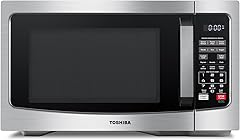 1 · Best Overall
Verdict: 1100W output and a humidity sensor that auto-adjusts cook time make this Toshiba the strongest standard microwave in the set.
- 34.8 pounds Item Weight
- 1100 watts Wattage
- 120 volts Voltage
- 1600 watts Power Consumption
Best for Households that reheat varied foods daily and want the microwave to judge doneness automatically
Skip it if Counter shelves are shallow; the Toshiba 0.9 at 13.3 inches deep gives back over an inch of depth.
Against the next pick: Toshiba 1.2 adds sensor cooking the Air Fryer Combo cannot match, but the combo covers air frying, convection, and grill in a 1.0 cu.ft cavity at 1000W.
Also sold as: 1.0 Cu.Ft.-Black Stainless Steel, 0.9 Cu.Ft.-Stainless Steel, 1.6 Cu.Ft.-Black Stainless Steel, 1.2 Cu.Ft.-Black.
The humidity sensor’s value is most apparent for reheating varied portions—it reads steam rather than relying on a preset countdown, which no other standard microwave in this group replicates. The practical difference shows up most when reheating mixed leftovers where a single timer setting would over- or under-heat one component.
Footprint demands attention: 20.6 inches wide, 14.6 inches deep. The 12.4-inch turntable—the widest among non-combo picks—accommodates larger plates and containers, but the counter slot needs to be measured first. Up to three time-and-power combinations can be saved as one-touch memory presets; none of the 700W picks in this set offer that convenience.
Shoppers searching for the best home microwave with auto-sensing will find this is the ceiling of the standard (non-combo) category here. The step up to the Toshiba Air Fryer Combo adds multi-modal cooking but drops sensor functionality entirely—a genuine trade-off rather than a straight upgrade.
Full listing specifications
| Additional Features | ECO+Mute, Humidity sensor |
|---|---|
| Wattage | 1100 watts |
| Controller Type | Touch |
| Power Consumption | 1600 watts |
| Voltage | 120 volts |
| Human Interface Input | Buttons, Keypad |
| Number of Power Levels | 10 |
| Timer Function | Timer Function Available |
| Energy Consumption | 1550 watts |
| Heating Method | Microwave |
2. Toshiba Air Fryer Combo — eight modes in one cavity
 2 · Best Multifunctional
Verdict: Eight cooking modes including air fry, convection bake, and broil make this Toshiba the right pick when replacing a standalone air fryer is the goal.
- 39.2 pounds Item Weight
- 1000 watts Wattage
- 120… Voltage
- 1600 watts Power Consumption
Best for Kitchens that want to consolidate a microwave and a standalone air fryer into one appliance
Skip it if You need only straight microwaving; the Toshiba 1.2 covers that at a shallower footprint without the added depth.
Against the next pick: The combo needs 3 more inches of depth than the BLACK+DECKER 0.9, but exchanges that trade-off for six additional cooking modes.
Not stated on the listing: energy consumption. Also sold as: 1.2 Cu.Ft.-Stainless Steel, 0.9 Cu.Ft.-Stainless Steel, 1.6 Cu.Ft.-Black Stainless Steel, 1.2 Cu.Ft.-Black.
Air frying, convection baking, broiling, combination cooking, low-temperature mode, and odor removal all run in the same cavity as the microwave. The 12.4-inch position-memory turntable—identical in diameter to the Toshiba 1.2—is listed as capable of fitting a whole roasted chicken, a 12-inch pizza, or an 8×4-inch casserole, which makes the multi-mode case practical rather than theoretical.
The knob-and-touch hybrid control panel is unique among these six picks; every other model uses touch-only or button-only inputs. At 1000W microwave output with 1600W of input power, the cavity heats at a competitive rate for a mid-size unit—though it draws the same 1600W input as the Toshiba 1.2, which produces 100W more microwave output from that same draw.
Depth is the hard constraint: 16.4 inches versus 13.0–14.6 inches for the other five picks. Energy consumption is not stated in the listing. For pure microwave use without air frying or convection, the Toshiba 1.2 covers the same counter at a meaningfully shallower footprint.
Full listing specifications
| Additional Features | Child Safety Lock, Control Panel Lock, Defrost, One Touch Button, Timer |
|---|---|
| Wattage | 1000 watts |
| Controller Type | Knob, Touch |
| Power Consumption | 1600 watts |
| Voltage | 120 volts_of_alternating_current |
| Human Interface Input | Buttons, Keypad |
| Number of Power Levels | 10 |
| Timer Function | Timer Function Available |
| Heating Method | microwave radiation, convection heat, grill |
| Defrost System Type | Defrost |
3. BLACK+DECKER 0.9 Cu.Ft — Quick Defrost at mid-size
 3 · Best Mid-Size
Verdict: Quick Defrost and 900W output in a 0.9 cu.ft footprint that fits counter arrangements the larger Toshiba models would not.
- 12.6 kg Item Weight
- 900 watts Wattage
- 120 volts Voltage
- 900 watts Power Consumption
Best for Mid-size kitchens that want 900W output and Quick Defrost without sensor complexity or multi-mode features
Skip it if Sensor cooking matters more than Quick Defrost; look at the Toshiba 1.2 for auto-adjusted heating.
Against the next pick: BLACK+DECKER 0.9 has Quick Defrost the Toshiba 0.9 lacks; Toshiba 0.9 counters with 11 power levels and a 2.88 lb weight advantage.
Also sold as: 1.7 Cu.Ft White, 1.7 Cu.Ft Black, 1.4 Cu.Ft Stainless Steel, 1.7 Cu.Ft Stainless Steel.
Quick Defrost—the only such designation in this set—stands out against the standard defrost listed on the Toshiba 0.9. At 18.7 inches wide and 13.4 inches deep, the footprint sits between the 700W compact picks and the 20.6-inch Toshiba models, making it manageable for most kitchen counters without giving up meaningful capacity.
The listing does not state item weight for either 900W pick, so a direct weight comparison is not possible. Power consumption equals the rated microwave output, a lower draw than the 1400W input the Toshiba 0.9 requires for the same output level. The door frame is listed as stainless steel with a black enclosure; a uniform finish this is not, which is worth checking against the existing kitchen.
No sensor cooking, no memory presets, no ECO mode. For a household where Quick Defrost and 900W speed cover daily needs without extras, this mid-size BLACK+DECKER is practical. For programs like Keep Warm or Soften, the Toshiba 0.9 is the direct comparison at the same wattage.
Full listing specifications
| Additional Features | Child Safety Lock |
|---|---|
| Wattage | 900 watts |
| Controller Type | Touch |
| Power Consumption | 900 watts |
| Voltage | 120 volts |
| Human Interface Input | Buttons |
| Number of Power Levels | 10 |
| Timer Function | Timer Function Available |
| Energy Consumption | 900 watts |
| Heating Method | microwave radiation |
4. Toshiba 0.9 Cu.Ft — 11 levels with Keep Warm and Soften
 4 · Best for Families
Verdict: Eleven power levels and Keep Warm plus Soften programs give this 900W Toshiba the most versatile cooking program list at the 0.9 cu.ft mid-size.
- 24.9 pounds Item Weight
- 900 watts Wattage
- 120… Voltage
- 1400 watts Power Consumption
Best for Families who regularly use Keep Warm and Soften functions at a 900W mid-size capacity
Skip it if Quick Defrost is a priority; the BLACK+DECKER 0.9 lists it at nearly the same dimensions.
Against the next pick: Toshiba 0.9 outpaces the COMFEE' by 200W of output and adds Keep Warm programs, but COMFEE's ECO mode and 20.2 lb mass suit compact, energy-aware setups where wattage isn't the priority.
Not stated on the listing: energy consumption. Also sold as: 2.2 Cu Ft, 0.7 Cu Ft.
Keep Warm, Soften, and Preheat programs appear alongside standard defrost and reheat—a list that covers more daily cooking scenarios than the five food presets on the BLACK+DECKER 0.9. For households that use the microwave to soften butter before baking, or hold dishes at serving temperature, those extra programs remove manual workarounds.
External dimensions of 18.7 inches wide and 13.3 inches deep are almost identical to the BLACK+DECKER 0.9, so counter fit is effectively the same decision. Input power is 1400W; the two-step child lock requires a deliberate two-stage action, adding one more physical barrier against unintended use by young children.
Energy consumption is not stated in the listing. Neither 900W pick here has sensor cooking—that separates both from the top-ranked Toshiba 1.2. Standard defrost (not Quick Defrost) means the BLACK+DECKER 0.9 may have a speed advantage for defrost-heavy use.
Full listing specifications
| Additional Features | Child Safety Lock, Control Panel Lock, Defrost, One Touch Button, Timer |
|---|---|
| Wattage | 900 watts |
| Controller Type | Touch |
| Power Consumption | 1400 watts |
| Voltage | 120 volts_of_alternating_current |
| Human Interface Input | Buttons |
| Number of Power Levels | 11 |
| Timer Function | Timer Function Available |
| Heating Method | microwave radiation |
| Defrost System Type | Defrost |
5. COMFEE' 0.7 Cu.Ft — ECO mode and lightest build
 5 · Best for Energy Saving
Verdict: ECO mode cuts standby power by 50%—listed only on this COMFEE'—making it the right 0.7 cu.ft pick for energy-aware households.
- 20.2 pounds Item Weight
- 700 watts Wattage
- 110 volts Voltage
- 1050 watts Power Consumption
Best for Energy-aware households in compact spaces that run the microwave on a live outlet continuously
Skip it if Output above 700W is needed; the Toshiba 0.9 at 900W adds Keep Warm and Soften programs at mid-size.
Against the next pick: COMFEE' has ECO mode and 11 power levels the Chefman lacks; Chefman's 12.93-inch depth is 0.07 inches shallower—the shallowest in this set.
Also sold as: Classic White, Modern Black, Modern White.
The ECO mode turns off the LED display during standby and cuts idle draw—the only feature of its kind among these six picks. For a microwave that stays plugged in around the clock, standby consumption accumulates; for intermittent or occasional use, the advantage is narrower.
Eleven power levels sit above the standard ten on the Chefman and BLACK+DECKER models, adding one extra step between settings—useful for tasks like softening without fully melting. The button-only controller (no touch panel) is a physical preference: quicker tactile feedback, but visually different from the touch-panel majority here. Mute function silences all beeps by holding the sound button for three seconds, with no menu navigation required.
Output is 700W, 200W below the mid-range picks in this set. The listing’s frequency value of 108 MHz is a known listing error; the brand does not publish a corrected figure. No sensor cooking, no memory presets.
Full listing specifications
| Additional Features | Child Safety Lock |
|---|---|
| Wattage | 700 watts |
| Controller Type | Button |
| Power Consumption | 1050 watts |
| Voltage | 110 volts |
| Human Interface Input | Buttons |
| Number of Power Levels | 11 |
| Timer Function | Timer Function Available |
| Energy Consumption | 1050 watts |
| Heating Method | Electric |
6. Chefman 0.7 Cu.Ft — shallowest footprint with mute
 6 · Best Compact
Verdict: At 12.93 inches deep, this Chefman has the shallowest footprint in the set, with a named mute button and a dishwasher-safe glass turntable.
- 23.8 pounds Item Weight
- 700 watts Wattage
- 120 volts Voltage
- not stated Power Consumption
Best for Narrow shelves or galley kitchens where counter depth below 13 inches is a hard constraint
Skip it if Counter depth is not a constraint; the COMFEE' adds ECO mode and an extra power level at similar dimensions.
Against the next pick: COMFEE's ECO mode and 11 power levels give it more features at 20.2 lb; this Chefman trades those extras for the shallowest depth in the set.
Not stated on the listing: timer function, energy consumption, turntable diameter. Also sold as: 0.9 Cu. Ft / Black, 0.9 Cu. Ft / Stainless, 0.7 Cu. Ft / Stainless.
At 17.52 inches wide and 9.53 inches tall—the shallowest depth of any pick here—this Chefman fits a narrow shelf or galley counter where front-to-back space is the binding constraint. All other 0.7 cu.ft picks in this set run 13.0 inches or deeper, making the difference real for tight installations.
At 23.8 lb, the listing states its item weight; neither the COMFEE' nor the BLACK+DECKER 0.9 listing states item weight, so a direct weight comparison is not possible. Ten power levels and six cooking presets cover standard daily use; there is no ECO standby mode and no sensor cooking. The 1-year assurance and cETL approval are listed by the brand. Other sizes (0.9 cu.ft) and a stainless finish are available in the same product family.
Power consumption is not stated in the listing, and turntable diameter is also absent—two figures the COMFEE’ and BLACK+DECKER models do state. For a compact kitchen that searches for the best home microwave at the smallest depth, that depth advantage over every other pick here may outweigh the missing specs; for all other situations, the COMFEE’ or Toshiba 0.9 offer more documented capability.
Full listing specifications
| Additional Features | Mute Button |
|---|---|
| Wattage | 700 watts |
| Controller Type | Touch |
| Voltage | 120 volts |
| Human Interface Input | Buttons |
| Number of Power Levels | 10 |
| Heating Method | Radiant |
| Defrost System Type | Defrost |
| Cooking Program | Defrost |
| Frequency | 2.45 GHz |
What to check before you buy
- Output wattage: 700W handles basic reheating; 900W cuts cycle times noticeably; 1100W (Toshiba 1.2) is the fastest in this set for boiling and large defrost tasks.
- Cavity capacity: 0.7 cu.ft fits a dinner plate; 0.9–1.0 cu.ft fits a standard casserole; 1.2 cu.ft (Toshiba 1.2) handles larger dishes and a 12.4-inch turntable.
- Footprint depth: Ranges from 12.93 in (Chefman) to 16.4 in (Toshiba Combo). Measure your shelf or counter slot before ordering—depth variation is larger than width variation across this set.
- Sensor vs. timer cooking: Only the Toshiba 1.2 in this set has a humidity sensor. Every other pick requires you to set time and power manually.
- Number of power levels: Ten is standard across four picks; the COMFEE’ and Toshiba 0.9 each offer 11, giving finer control for tasks like softening without melting.
- Combo functions: The Toshiba Air Fryer Combo adds air frying, convection, and broiling. No other pick here does any of those; a standard microwave cannot substitute.
- Child lock type: All six picks include a child lock. The Toshiba 0.9 and Toshiba Air Fryer Combo list a two-step version that requires a deliberate two-stage action.
How much of each spec do you actually need?
How much wattage does your kitchen actually need?
700W covers reheating, popcorn, and defrost in a low-use setting. At 900W, cycle times are shorter for the same tasks—the physics of higher output power mean faster energy transfer to food. The 1100W Toshiba 1.2 is the highest output here and makes the largest difference for tasks like rapidly defrosting dense proteins or boiling water. Related guide: best microwave popcorn maker.
How much capacity is enough?
The 0.7 cu.ft picks (Chefman, COMFEE’) fit a standard dinner plate. At 0.9 cu.ft (BLACK+DECKER 0.9, Toshiba 0.9), there is room for a casserole or a larger bowl. The Toshiba 1.2 and the combo, with their 12.4-inch turntables, fit a 12-inch pizza or a full roasted chicken.
Does a humidity sensor change how you cook?
Sensor cooking—available only on the Toshiba 1.2 in this set—reads steam from the food and stops the cycle when it detects the right level. Without it, you set a timer and check manually. For reheating, the difference is most apparent with varied portion sizes where a single preset time under- or over-heats.
Should you pay for an air fry combo?
If you use an air fryer regularly, the Toshiba Air Fryer Combo consolidates two appliances into one cavity. The trade-off is counter depth: 16.4 inches versus 13–14 inches for the standard picks. If the microwave is mostly for reheating and defrosting, an 8-in-1 unit adds complexity and depth without matching benefit.
How many power levels do you need?
Ten levels cover almost all cooking tasks—low for melting, medium for gentle reheating, high for full power. The COMFEE’ and Toshiba 0.9 each offer 11, which adds one extra step between settings. The difference is marginal for most reheating tasks but meaningful for precise work like softening butter without melting it.
Does standby power draw matter?
A microwave plugged in around the clock draws power even when idle. The COMFEE’s ECO mode is the only feature in this set listed as cutting standby draw—by 50% according to the brand. For intermittent use where the microwave is unplugged between sessions, standby draw is a non-issue; for a permanently connected appliance, it accumulates over months.
Which microwave fits your situation?
You live in a studio apartment or dorm
Depth and weight matter most. The Chefman 0.7 Cu.Ft at 12.93 inches deep fits a narrow counter or small cart. The COMFEE' ECO mode helps if the outlet stays live. Both output 700W, sufficient for single-serving reheating and popcorn.
You cook for a family and use the microwave every day
Output wattage and program variety decide it. The Toshiba 1.2 Cu.Ft at 1100W with sensor reheat handles large portions in a high-use household without manual timer guesswork. The Toshiba 0.9 at 900W with Keep Warm and Soften programs suits a family that also uses the microwave for side-task cooking, not just reheating.
You want to consolidate your microwave and air fryer
Counter depth must be at least 16.4 inches (plus rear clearance) for the Toshiba Air Fryer Combo. Its 20.6-inch width and 16.4-inch depth make it the most committed installation in this set. If the existing air fryer sits on the same counter, replacing both with one unit frees up space overall. The 1000W microwave output is competitive with the other mid-range picks.
You have young children in the kitchen
Child locks appear on all six picks. For the most resistant protection, the Toshiba 0.9 and Toshiba Air Fryer Combo list two-step child locks requiring a deliberate two-stage action to open. The Chefman lists a child safety lock specifically on the door handle. Any of the six provides a barrier; the two-step version adds one extra stage.
You need a microwave for a shared office break room
The BLACK+DECKER 0.9 at 18.7 inches wide and 900W handles varied user loads efficiently, with Quick Defrost for frozen lunches and 10 preset programs. The 700W compact picks are lighter and easier to relocate, but 700W may slow multi-user peak periods when several people reheat in sequence.
The competition
- BLACK+DECKER 0.7 Cu.Ft Microwave Beaten on a listed spec The BLACK+DECKER 0.9 delivers 900W in a comparable footprint width, making this 700W version redundant when the COMFEE' already covers the compact 700W space with ECO mode and 11 power levels.
- Farberware 0.7 Cu.Ft Microwave Beaten on a listed spec The Chefman 0.7 Cu.Ft matches its 700W output while adding a named mute function and a dishwasher-safe turntable the Farberware listing does not detail; the cooking program field lists only '6' with no program names.
Who should buy what
The Toshiba 1.2 Cu.Ft is the strongest standard microwave in this set for a household that reheats varied foods daily—1100W output and sensor cooking put it ahead of every other pick for general use. The Toshiba Air Fryer Combo wins in the specific case of a kitchen that also wants air frying and convection in one cavity, and has the counter depth to accommodate 16.4 inches.
Skip the best microwave category altogether only if counter depth is under 12.93 inches; no pick in this set fits shallower than that, and the Chefman is the only one close. For every other kitchen, the choice comes down to wattage, program variety, and whether standby ECO savings or multi-modal cooking is worth the trade-off in size.
What changed
- Published guide
- Guide drafted